
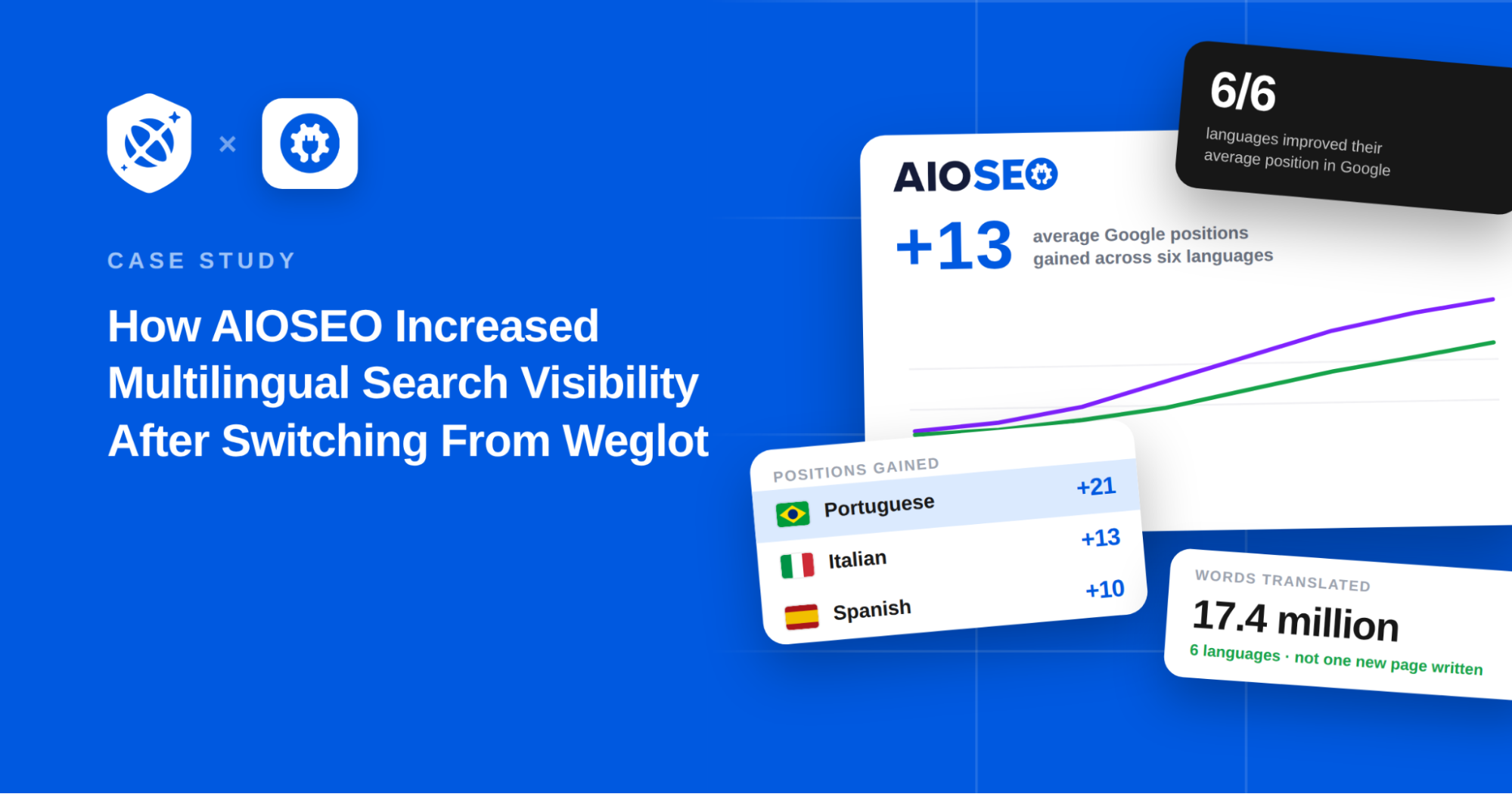
17.4 million translated words, six languages, and higher Google rankings across every one.
| Industry | WordPress plugins and software |
| Region | United States |
| Site type | Plugin website |
| Languages | German, Spanish, French, Italian, Japanese, and Brazilian Portuguese |
| Words translated | 17.4 million |
| Platform | WordPress |
Meet All in One SEO (AIOSEO)
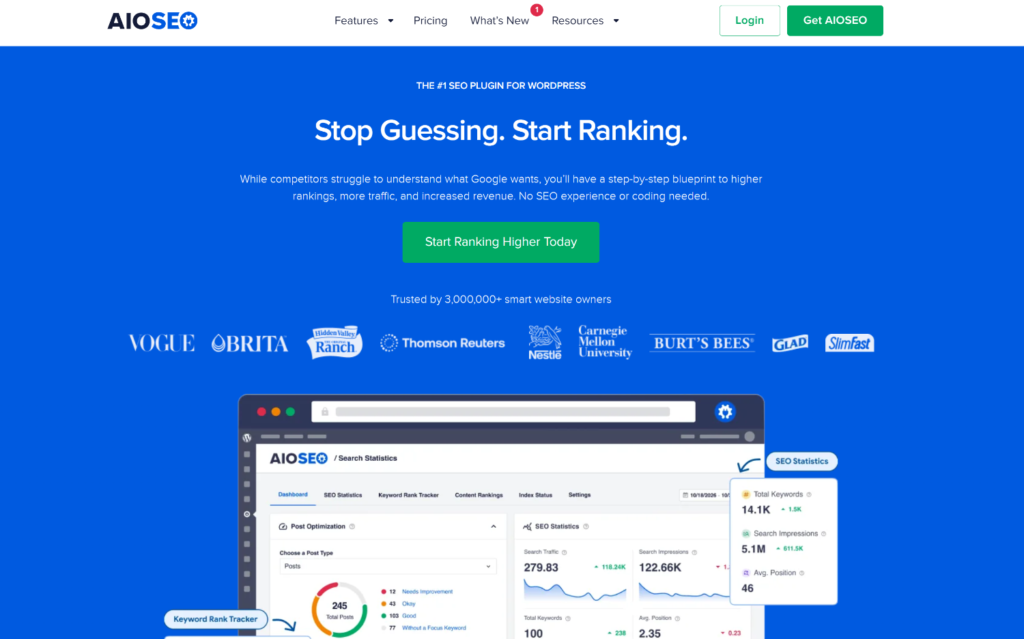
All in One SEO (AIOSEO) is the WordPress SEO plugin used by more than 3 million websites.
It handles the technical groundwork that helps pages rank, including titles and meta descriptions, schema markup, XML sitemaps, redirects, internal linking suggestions and site audits.
The plugin is designed so that business owners with no SEO background can get the fundamentals right, while still giving agencies and developers the advanced tools they need.
AIOSEO is one of the most established names in WordPress SEO, and its team has spent years helping website owners improve their search visibility.
The team had already applied that same international thinking to its own website.
The Challenge: Getting More From an Already Translated Website
AIOSEO had already invested in making its website available internationally.
Using Weglot, the team had translated its product pages, documentation, guides, and marketing content into six languages, covering 17.4 million words in total.
The translated pages were live, indexed, and already giving AIOSEO a presence in international search results.
But the team could see an opportunity to get more from them.
Across the six languages, many pages were still ranking beyond the first page of Google. The content existed, and the translations were in place, but there was considerably more search visibility available if those pages could move higher.
AIOSEO did not need to create more content or add more languages.
It wanted to improve the performance of the multilingual website it had already built.
That meant looking beyond translation alone and finding a platform that could strengthen the technical multilingual SEO setup behind every translated page as well.
The Solution: Switching to Universally
AIOSEO moved its multilingual website from Weglot to Universally.
The content and languages stayed the same, and the team did not publish hundreds of new pages.
What changed was the platform powering the translated website and the technical setup used to present those pages to search engines.
AIOSEO connected its existing WordPress website to Universally, which translated and served the full site across six languages:
- German
- Spanish
- French
- Italian
- Japanese
- Brazilian Portuguese
That included 17.4 million words across its product pages, documentation, guides, and marketing content.
Context-aware AI handled the translations, helping the copy read naturally rather than like a word-for-word conversion.
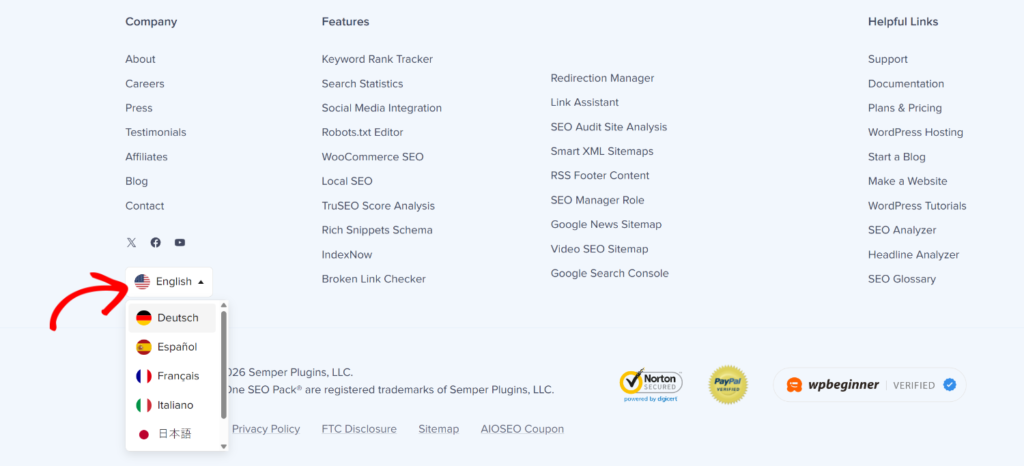
Universally added a clean language switcher that’s located in the footer of AIOSEO’s website. Users can click on it and change to their preferred language.
But Universally did more than translate what visitors could see.
It also set up the technical multilingual SEO that Google needed to discover, understand, and rank each language version of the website.
Every translated page received:
- A dedicated, indexable URL
- Translated page titles and meta descriptions
- Hreflang tags connecting the different language versions
- A clear language-specific version that Google could crawl and index
- Automatic updates when the original English content changes
Instead of treating translation as a layer of replacement text, Universally created complete, searchable versions of AIOSEO’s existing pages for each language.
That meant Google could recognise the relationship between the English page and its translated versions, understand which page was intended for which audience, and surface the appropriate version when someone searched in that language.
This is the difference between making a website readable in another language and setting it up to compete in multilingual search.
The translations were served through an external layer rather than being written into the WordPress database, allowing AIOSEO to manage a multilingual website of this size without adding millions of translated words to WordPress.
The team could strengthen the technical foundation of its international search presence without creating new content, involving developers, or maintaining separate websites for each market.
The Results: Higher Rankings Across Every Language
Five languages moved to Universally in December 2025, with Brazilian Portuguese following a few months later.
Every single language improved its average position on Google.
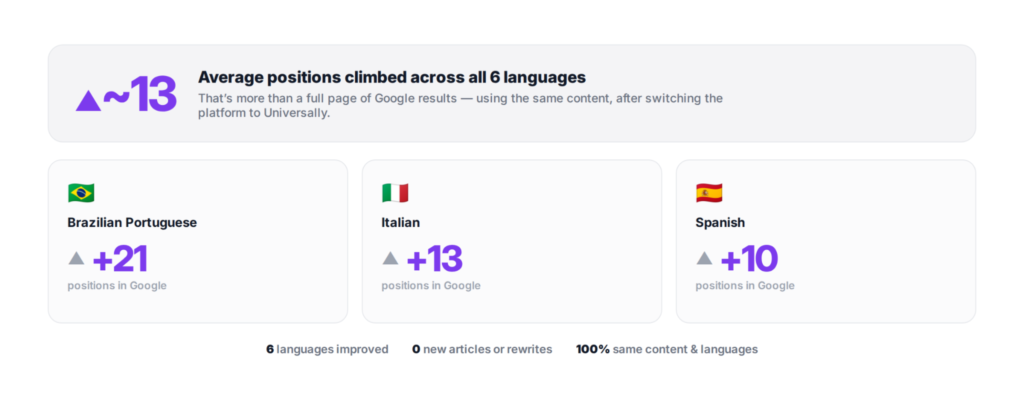
Across all six languages, AIOSEO’s translated pages climbed by an average of nearly 13 positions. That is the equivalent of moving more than an entire page of Google results using the same content the team already had.
Italian climbed 13 positions. At the same time, clicks increased by 44%, and impressions rose by 29%.
Spanish climbed more than 10 positions, while clicks increased by 19% and impressions rose by 32%.
Brazilian Portuguese delivered the largest improvement.
Despite launching later than the other languages, it climbed more than 21 positions in roughly three months.
The same pattern appeared across the entire multilingual website. Every language moved up, giving AIOSEO more opportunities to be seen by people searching in their own language.
None of these gains came from publishing more articles, rewriting the website, or commissioning another translation project.
The content and languages stayed the same, but after AIOSEO changed the platform and multilingual SEO setup powering those pages, its existing content began performing better in search.
More Value From 17.4 Million Translated Words
AIOSEO had already invested in creating an extensive website filled with product information, educational content, and technical guidance.
Universally allowed that same content to work harder across six languages.
One guide could answer a question in English, German, Spanish, French, Italian, Japanese, and Brazilian Portuguese.
One product page could compete for visibility across seven different sets of search results.
One update to the original website could be reflected across every translated version without the team manually maintaining separate pages.
Crucially, each of those translated pages was not only readable by visitors. It was also supported by the technical multilingual SEO needed to give it a stronger opportunity to appear in Google.
AIOSEO did not need to create more content to increase its international search visibility. It needed the content it had already created to be translated, structured, and presented to search engines more effectively.
The Reach This Opened Up
AIOSEO’s six translated languages represent an audience of more than 1.4 billion speakers worldwide:
- Spanish: 559 million speakers across Spain, Latin America, and the United States
- French: 310 million speakers across Europe, Africa, and the Americas
- Brazilian Portuguese: Roughly 210 million speakers, anchored by Brazil
- German: 135 million speakers across some of the highest-GDP markets in the EU
- Japanese: 125 million speakers in one of the world’s most mature digital economies
- Italian: 68 million speakers across Italy and beyond
AIOSEO already had content for these audiences. By improving the search visibility of its translated pages, it gave more people the opportunity to discover its product, documentation, and expertise in their own language.
Every language represents another market in which AIOSEO can rank and another audience it can support without employing a translation team or maintaining a separate website.
In Their Words
“I was skeptical that just changing platforms could move rankings without new content, but watching every one of our six languages climb in Google, some by double digits, changed my mind pretty fast.”
Gabriela Jhean, Editor
AIOSEO
Try It on Your Own Site
AIOSEO already had a translated website.
After switching from Weglot to Universally, every language improved its average position on Google. Across the multilingual website, rankings climbed by an average of nearly 13 positions without a single new page being written.
The content did not change. The languages did not change.
What changed was the platform powering the translated pages and the technical multilingual SEO supporting them.
Universally does not just translate your website. It creates complete, searchable versions of every page, with dedicated URLs, translated metadata and hreflang tags built in.
Translate your entire website into 110+ languages, strengthen your international search visibility, and keep your site fast.
Translate your website into 110+ languages today with Universally.


Add a Comment